The Neuroscience of Change: How to Lead Through Uncertainty
If you are leading a team through a major shift right now, you know that heavy, "walking on eggshells" feeling that settles over the office. You have probably done everything right on paper. You mapped out the new org chart, updated the goals, and sent the memo. But the energy in the room is still flat, and you are not sure why.

Here is what I see most often in my work as a leadership coach: leaders treating change like a logistics problem. Move the pieces. Update the process. Communicate the plan. But as organizational theorist William Bridges put it, "Without a transition, a change is just a rearrangement of the furniture."
The furniture has moved. But your people are still standing in the old room, trying to figure out what just happened.
When I train leaders and organizations on navigating change, I focus on three interconnected pieces: change, transition, and psychological safety. Understanding how these work together (and what happens when one is missing) is the difference between a rollout that sticks and one that quietly unravels.
Change vs. Transition: Why the Distinction Matters
Change is external. It is the restructure, the new strategy, the leadership shift, the system migration. It happens on a timeline, and it can be managed like a project.
Transition is internal. It is the psychological journey your people must navigate before the new reality can actually take hold. It is messier, slower, and far less linear than any org chart suggests.
This is not just a philosophical distinction. It has real behavioral consequences. When leaders focus only on the logistics of change and skip the work of transition, teams get stuck. Productivity dips. Passive resistance shows up. People go through the motions without real buy-in.
Psychological safety is the environment that makes transition possible. It is what allows people to ask the questions they are afraid to ask, admit the confusion they are afraid to admit, and take the risks they need to take to grow into the new reality. Without it, change is just compliance.
Why Your Team Is Wired to Resist Change

Before you label a resistant employee as difficult, consider what is actually happening in their nervous system.
Research published in the Annual Review of Physiology (Okazawa & Kiani, 2023) highlights that our brains are built for "stationary" environments, ones where the rules and stimuli are consistent and repeating. When we introduce non-stationary environments, such as a corporate restructure or a strategic pivot, the brain shifts into what researchers call "hierarchical inference." In plain language: the brain has to stop and figure out which information even matters anymore, which rules still apply, which signals to trust. That takes significantly more cognitive energy than operating in a familiar environment.
Add to that a principle most neuroscientists agree on: neurons that fire together, wire together. Every time your team completes a task the old way, they are reinforcing a deeply grooved neural pathway. It is efficient. It is comfortable. It is, biologically speaking, the path of least resistance.
When you introduce a major change, you are not just asking people to do something different. You are asking them to bulldoze a paved highway and hack a new path through the jungle with a machete. That is not resistance for the sake of drama. That is exhaustion.
And here is where it gets even more relevant for leaders: the brain does not distinguish between physical threats and social ones. Using David Rock's SCARF model, we know that the brain's threat response is triggered by perceived loss across five domains: Status, Certainty, Autonomy, Relatedness, and Fairness. When a leader announces a restructure without addressing what it means for any of those five areas, teams do not get curious. They get scared. And a scared nervous system defaults to contraction, not creativity.
You can see it in the boardroom. Short-sighted decisions. Shallow breathing. The questions nobody asks out loud.
Mindset + Energy = Impact: What Leaders Are Actually Radiating
Every leader has a choice in how they show up during a transition. That choice matters more than most leaders realize, because energy is contagious.
When I work with leaders through the Mindset + Energy = Impact framework, we look at two distinct mindset orientations and what they produce.
A fixed mindset treats the disruption of change as evidence of failure. It views effort as wasteful when the outcome is unclear and avoids challenges that feel too uncertain. Leaders operating from this orientation do not intend to demoralize their teams. But when the person at the top is radiating "this is a problem," the team mirrors it back.
A growth mindset treats the disruption of change as data. It looks for the opportunity embedded in the mess and views uncertainty as a legitimate part of the process. This is not toxic positivity. It is not pretending nothing is hard. It is a conscious, practiced choice to remain curious when the instinct is to contract.
Now layer energy on top of mindset. When leaders are operating from high, anabolic energy, they are expansive, solutions-focused, and energizing to be around. When they are operating from low, catabolic energy, they are reactive, heavy, and draining, even when they are trying hard.
The combination of a growth mindset and high-level energy is what shifts a leader from someone who manages a process to someone who genuinely moves people. That is where impact lives.
Navigating the Messy Middle: The Bridges Model in Practice
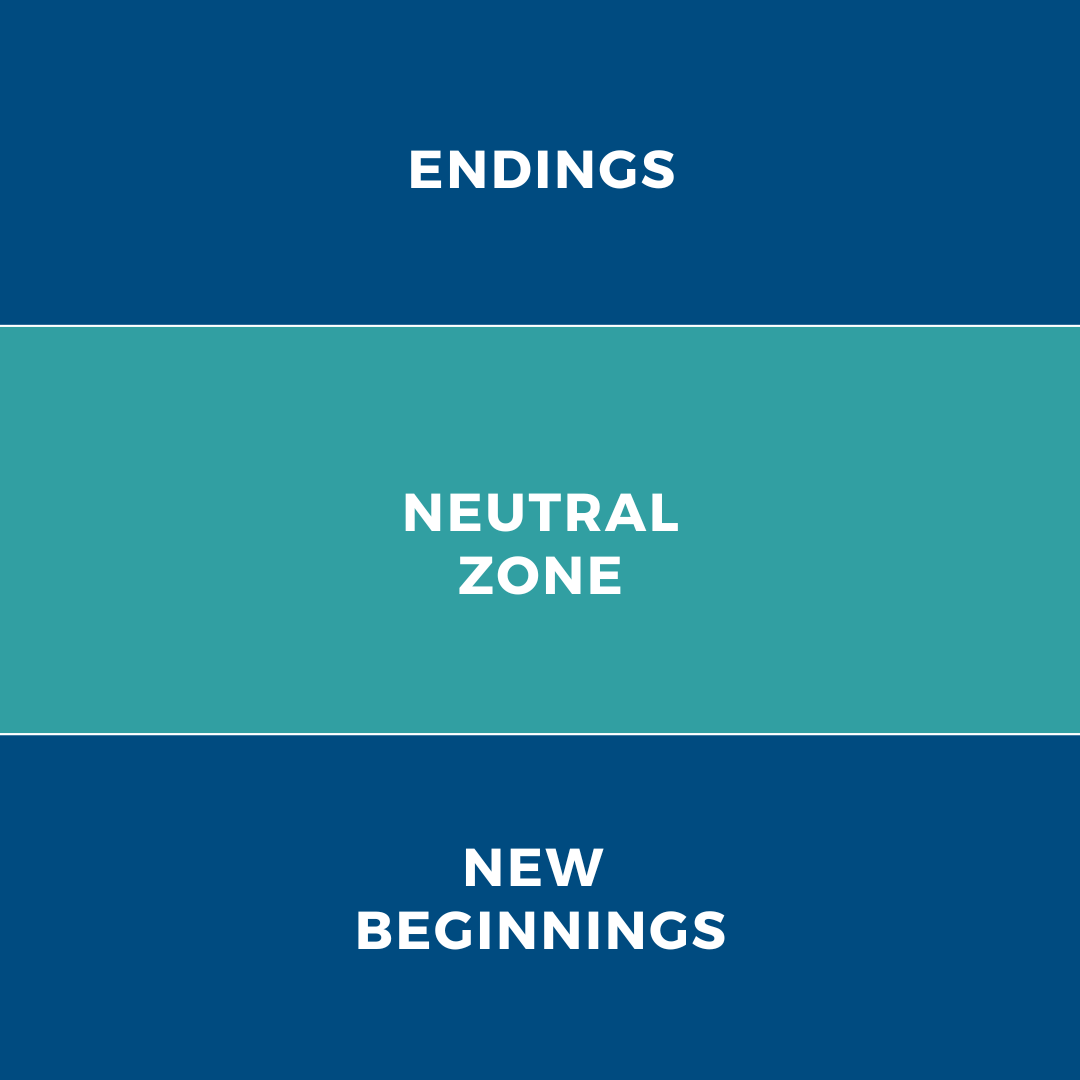
Every successful transition follows a predictable arc. William Bridges mapped it in three stages, and understanding where your team sits on this curve is one of the most useful diagnostic tools available to a leader.
Stage 1: The Endings
Bridges Transition Model
Every change begins with a loss. Before people can step into the new, they have to let go of the old. The old role. The old team. The old process. The old identity they built around the way things used to work.
High-impact leaders do not skip this stage. They name it. "I know we are asking you to give up something that worked. That is real, and it matters." Acknowledging loss is not weakness. It is the first act of psychological safety.
When leaders rush past this stage or dismiss it with "just be open to change," they do not make the grief go away. They just make it underground, where it quietly drives resistance, disengagement, and the "quiet quitting" that shows up months later.
Stage 2: The Neutral Zone
This is the messy middle. It is the stage most organizations try hardest to shorten and the stage that actually matters most.
The Neutral Zone is a period of disorientation. Old structures have dissolved; new ones have not yet taken hold. People feel anxious, unsure of their footing, unsure who they are in the new structure. Productivity dips. Emotional reactivity goes up. Meetings feel tense.
And here is the thing: all of that is also the birthplace of innovation.
Research on organizational change consistently shows that the teams who are allowed to sit in uncertainty and explore it, rather than being pushed to resolve it prematurely, generate the most creative solutions. When psychological safety is high in the Neutral Zone, people take the risks that lead to breakthroughs. When psychological safety is low, they just keep their heads down and wait it out.
Your job as a leader in this stage is not to fix the discomfort. It is to hold space for it while communicating a clear sense of purpose and direction. Two things can be true: "We do not have all the answers yet" and "Here is what we are working toward."
Stage 3: New Beginnings
This is where the energy shifts. People begin to see the purpose behind the change and to build a new sense of identity within the new system. Engagement comes back. Ownership returns. People stop mourning what was and start investing in what is.
But this stage does not happen on a leader's timeline. It happens when people have been given the space to move through the first two.
The leaders who try to force their teams to New Beginnings, through excitement campaigns and vision decks, before the team has processed the Ending, find themselves wondering why no one seems to mean it.
The Choice Point: A Real-Time Leadership Tool
Before your next town hall, your next all-hands, your next difficult one-on-one during a period of change, I want you to try something.
Pause. Ask yourself two questions:
→ How do I want the people in this room to feel when they leave?
→ What mindset and energy level would best serve this specific moment?
That pause is what I call the Choice Point. It is the moment between stimulus and response where leadership actually lives. It is brief. It requires no special tools. And it changes everything about how you show up.
Viktor Frankl wrote that “between stimulus and response there is a space, and in that space lies human freedom.” For leaders, that space is where the difference between reactive management and intentional leadership is made.
When you align the biological needs of your team, certainty, connection, status, fairness, with a clear and grounded energy, you create the conditions where change is not just tolerated. It is owned.
The Bottom Line
Change is not going away. If anything, the pace of it is accelerating. The leaders who will thrive are not the ones who can eliminate uncertainty or execute a flawless rollout. They are the ones who can stay present, stay grounded, and stay human in the middle of the mess.
That is what it means to lead the transition, not just the change.
Does your leadership team need to navigate the messy middle? I love helping organizations move past the friction of change and into a space of high-impact growth. Whether through 1:1 executive coaching or a custom workshop for your leadership team, let's find a way to make your next transition your most successful one yet.

Frequently Asked Questions
-
Change is the external event: the restructure, the new strategy, the system shift. Transition is the internal psychological process people must navigate as a result. Leaders often manage the change well but overlook the transition, which is why so many well-planned initiatives fail to stick. Both require intentional leadership.
-
Developed by organizational theorist William Bridges, the Bridges Transition Model describes three stages every person moves through during change: Endings (letting go of the old), the Neutral Zone (the disorienting in-between period), and New Beginnings (stepping into the new identity and reality). Leaders who understand where their team sits in this model can respond with the right support at the right time.
-
Resistance is rarely about stubbornness. It's rooted in neuroscience. The brain is wired to prefer familiar, predictable environments and treats ambiguity as a potential threat. When change disrupts status, certainty, or autonomy, the brain's threat response activates, making people cautious, reactive, and risk-averse. Understanding this helps leaders respond with empathy and structure rather than frustration.
-
The SCARF model, developed by neuroscientist David Rock, identifies five social domains the brain monitors for threat or reward: Status, Certainty, Autonomy, Relatedness, and Fairness. During organizational change, all five are often disrupted at once. When leaders communicate without addressing these needs, teams shift into a threat state that limits creativity, collaboration, and performance. Addressing SCARF proactively is one of the most effective ways to maintain psychological safety during a transition.
-
Psychological safety is the shared belief that a team environment is safe for interpersonal risk-taking: asking questions, admitting uncertainty, sharing concerns, and trying new approaches without fear of embarrassment or punishment. During transitions, psychological safety is what allows people to move through discomfort productively rather than shutting down or disengaging.