Mindset + Energy = Impact: The Framework Behind Every Conshy Coaching Engagement
Table of Contents
If you’ve spent any time on my blog, or attended any trainings or workshops I’ve facilitated, you have probably noticed three words appearing again and again. Across different topics, in different contexts, pointing back to the same place.
Mindset. Energy. Impact.
This is not a coincidence. Every piece of coaching work I do, whether it is a private one-on-one engagement, a leadership workshop, or an organizational training program, is built on the same underlying framework. And I realized I have referenced it dozens of times without ever writing the post that explains it properly.
This is that post. Bookmark it. It is the one I will keep linking back to.
The Framework
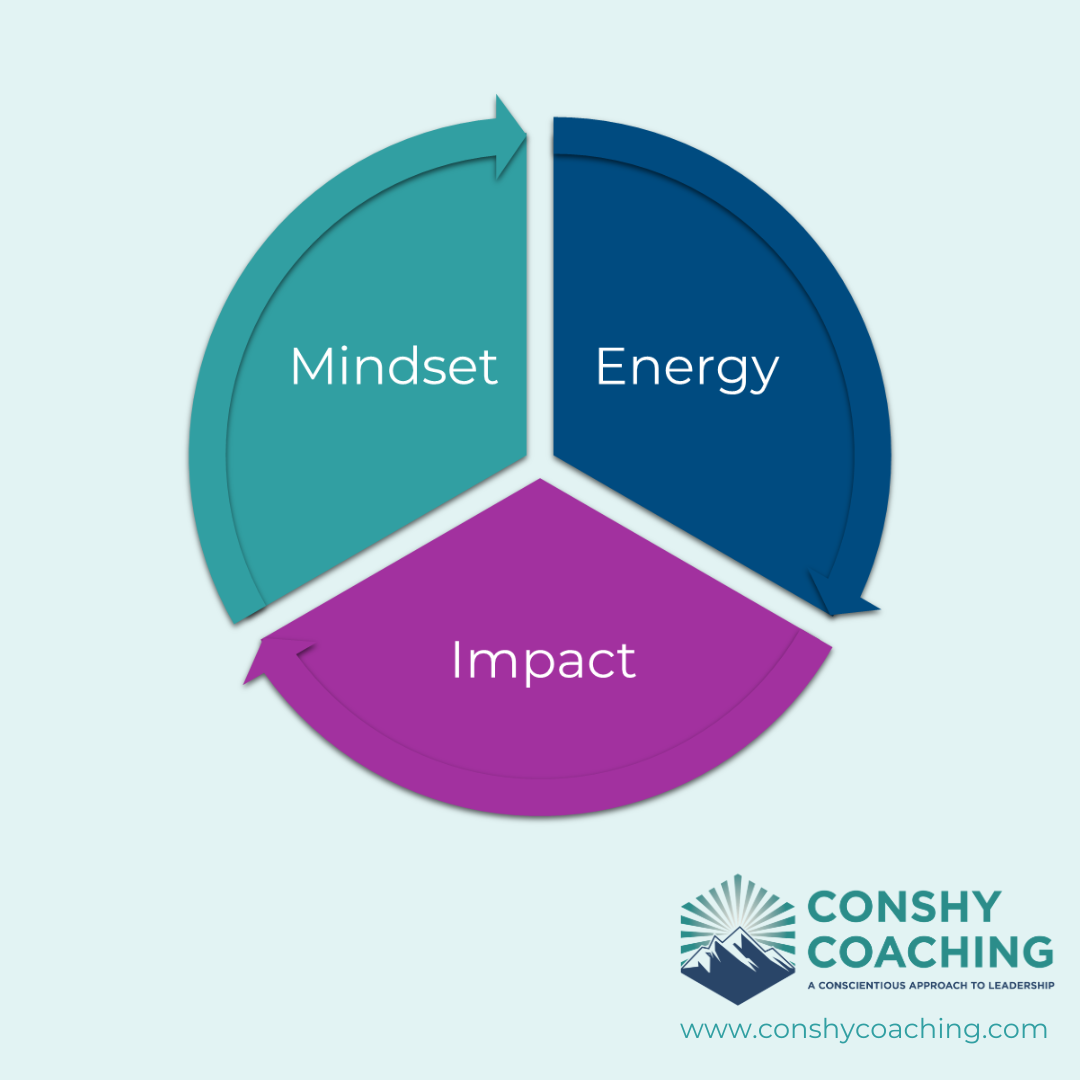
MINDSET + ENERGY = IMPACT
The premise is straightforward, even if the practice is not: your effectiveness as a leader is not primarily determined by your strategy, your experience, your technical skills, or your title. It is determined by the quality of thinking you bring to your work (mindset) and the internal state from which you lead (energy). When both are healthy and intentional, impact follows. When either is compromised, performance suffers, regardless of how talented, experienced, or motivated you are.
This matters because most leadership development programs focus almost exclusively on skills and strategy. New frameworks. New communication tools. New ways to structure a one-on-one or run a performance review. These are valuable. But they sit on top of a foundation that is rarely addressed directly.
If the foundation is cracked, the tools do not work as well as they should.
The First Component: Mindset

Mindset, in this framework, is not simply about whether you think positively or negatively. It is about the operating system running beneath your behavior, the beliefs, assumptions, and internal narratives that shape how you interpret challenge, receive feedback, make decisions, and relate to your own performance.
Most leaders are running at least one of two primary mindset patterns: Grounded (which are influenced by what renowned PhD, psychologist, author and researcher, Carol Dweck defines as Fixed) or Growth Mindsets.
The Proving, or Fixed, Mindset
This is the mindset of someone who, at some level, is still trying to earn their seat at the table. Every decision is a test. Every piece of feedback is evidence. Every result is filtered through the question: does this confirm that I belong here?
The proving mindset is exhausting and common. It shows up differently depending on who is carrying it. For some leaders it looks like over-explaining every decision, hedging every recommendation, and seeking approval before acting.
For others it looks like the opposite: defending positions past the point of reason, dismissing feedback without examining it, and equating their identity so tightly with their role that any challenge to the work feels like a challenge to the self.
One client described it perfectly: 'I spent the first twenty years of my career trying to prove I could handle it. By the time everyone agreed that I could, I had forgotten how to lead. I didn’t know how to delegate or trust my team to deliver results without micromanaging. I became a bottleneck.’
Another client described the proving pattern differently. She was a senior manager who rarely said no to anything. Her calendar was full to the point of being unworkable. She sat on every project, attended every meeting, and volunteered for initiatives that were well outside her lane. On the surface, she looked like a high performer. Underneath, she was operating from a quiet, persistent fear: that if she stepped back, said no, or left something undone, someone would notice she was not as indispensable as she needed to be. She was not proving capability through excellence. She was proving it through omnipresence.
The Grounded, or Growth, Mindset
This mindset orients toward learning, adapting, and getting better rather than proving and defending. Leaders operating from a grounded mindset approach difficulty as information, feedback as data, and failure as part of the learning arc rather than a verdict on their worth.

What distinguishes the grounded mindset is not optimism or positivity. It is a foundational confidence in capacity: the belief that even if I do not know the answer right now, I can find it. Even if I have not done this before, I can figure it out. The internal language shifts from “I don’t know how” to “I don’t know how yet.” That single word carries significant weight.
This is not the confidence of certainty. It is something more durable: the confidence of someone who trusts their own ability to learn. Leaders with a grounded mindset can stand fully in their value and worth while simultaneously acknowledging they have room to grow. These are not in tension. They are the same orientation. You can be excellent and still be a student. You can be a credible authority and still ask questions you do not know the answers to.
The grounded mindset also changes a leader’s relationship to failure. Rather than treating setbacks as evidence of inadequacy, leaders operating from this orientation treat them as data. What happened? What can be learned from it? What would I do differently? The failure becomes information rather than indictment, and the willingness to sit with that without collapsing is what allows genuine growth to happen.
One client, a Director of Operations, came into coaching after a high-visibility project had missed its timeline. She took full ownership of the miss in a meeting with senior leadership, something her team watched with visible surprise. In previous roles, she would have hedged, deflected, or presented an elaborate explanation of why it was not entirely her fault. Instead, she named what happened, identified what she would do differently, and presented a revised plan. Her team’s engagement shifted noticeably in the weeks that followed. People started bringing her real problems instead of pre-processed updates. Her one-on-ones got more substantive. And her own leadership felt, in her words, less like managing and more like actually leading. The shift had not come from a new strategy. It had come from a decision to stop treating failure as something to survive and start treating it as something to learn from.
The shift from proving to grounded is the most common and most impactful mindset work I do in coaching. It does not happen overnight. But even a small movement in that direction changes the quality of every leadership interaction.
📖 Keep reading: Mindset: The New Psychology of Success by Carol Dweck
The proving mindset shows up differently in different leaders. It has four distinct patterns, perfectionism, people-pleasing, hyper-achieving, and control, each of which is a learned behavior that worked until it didn't. I will cover all four in detail in its own dedicated post.
The Second Component: Energy
Energy is the most consistently underestimated by high-achieving leaders. Not because they do not understand that energy matters, but because they have spent years treating their own energy as a secondary consideration, something to manage around rather than invest in.
In this framework, energy is not physical stamina. It is the way we physically show up and approach situations, and how we are perceived by others, both of which directly impacts the quality of leadership a person can produce.
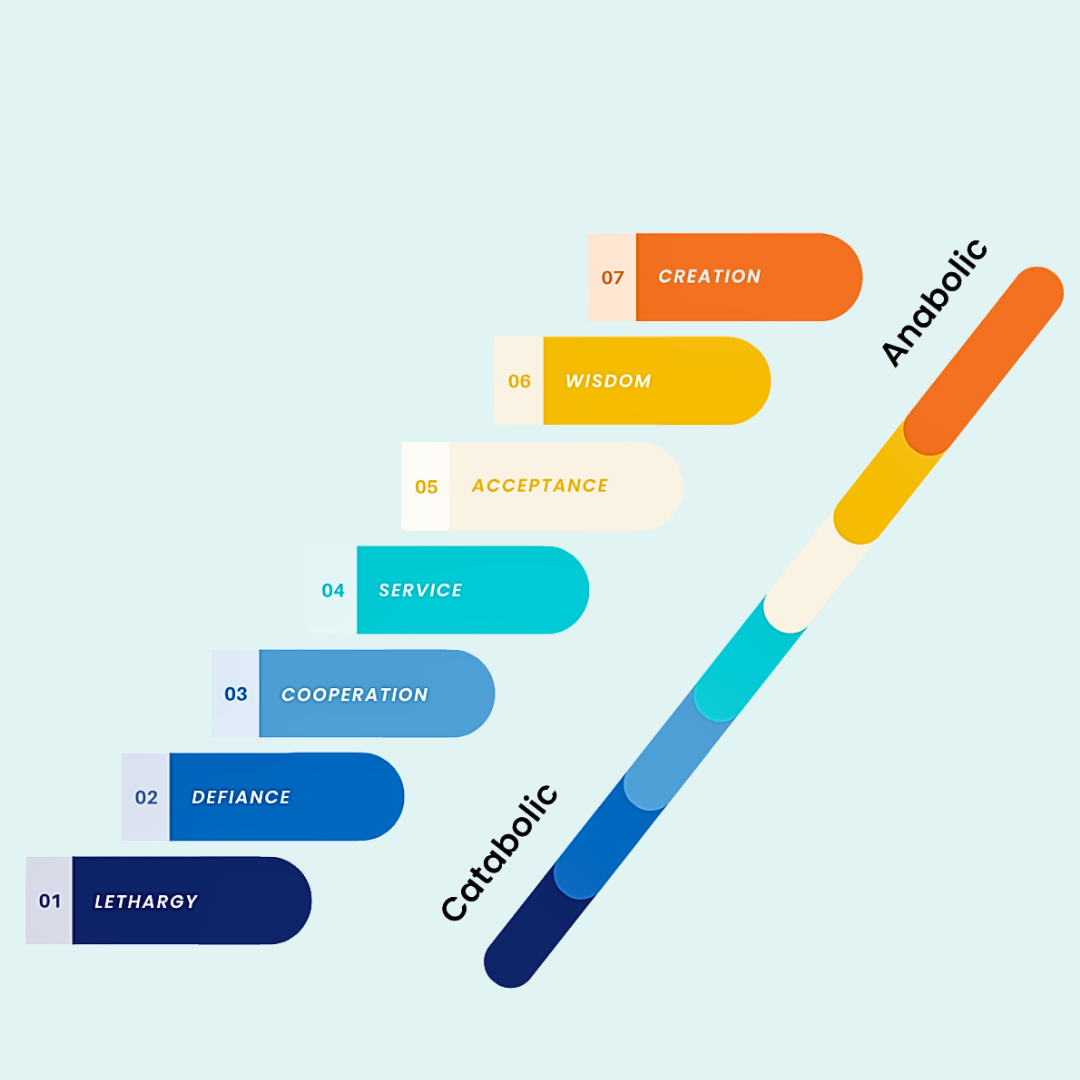
Energy, as it relates to leadership, in the simplest form, breaks into two types: anabolic and catabolic.
Catabolic energy is protective, destructive, and draining. It is most commonly associated with stress and the fight, flight, or freeze response. When stress is present, it is difficult to see past the stressor to the broader picture, and the choices available narrow accordingly: protect, survive, manage. When a leader is operating primarily from catabolic energy, the effects move outward. Teams in a chronic catabolic environment tend to manage information rather than share it, conversations become transactional, and the instinct to protect oneself from the stress at the top of the room takes precedence over genuine collaboration. Short-term output can remain high, even spike. But engagement erodes, psychological safety drops, and over time, the people with the most options leave.
One client, a VP of Engineering, arrived in coaching midway through an intense product cycle. He was delivering. His team was hitting milestones. From the outside, the picture looked fine. What emerged over our first few sessions was a leader operating entirely in triage mode, treating each conversation as a potential threat. His team, he told me, had started bringing him solutions rather than problems. When I asked why that bothered him, he said: “Because they’re not bringing me the real stuff anymore. They’re packaging it.” His team had read his stress accurately and had learned to protect him, and themselves, from it. The catabolic state he was in had not just narrowed his own thinking. It had changed what information was allowed to reach him.
Anabolic energy is constructive, proactive, and driving. When the brain is not under stress, it releases hormones designed to optimize rather than protect, which is why anabolic energy makes it easier to focus on solutions, access creativity, and hold a more complete view of any situation. As leaders shift from catabolic patterns into higher levels of anabolic energy, they move from self-protection toward self-mastery, and eventually toward a way of leading grounded in authenticity and purpose rather than fear. The effects on teams are tangible: people feel safe enough to bring real problems rather than managed versions of them, decisions improve, and culture is built not through policy but through the repeated experience of what it feels like to be in the room with someone who is genuinely regulated, curious, and present.
A client who leads a Chief of Staff function at a mid-sized company described noticing a shift after several weeks of working on her own energy state. She had started what she called arriving on purpose: taking a few minutes before any significant conversation to regulate, clarify her intention, and set aside whatever was following her from the previous meeting. Her team began telling her, unprompted, that her one-on-ones felt different. More substantive. Safer to be honest in. “I didn’t change the agenda,” she told me. “I just changed who showed up to it.” That is what anabolic energy produces: not a different set of skills, but a different quality of presence. And presence, it turns out, is what teams are responding to.
Neither type of energy is positive or negative, good or bad. Just like a stock in the stock market, our energy, emotions, and behaviors fluctuate based on how we perceive and respond to what’s happening in our life, and at work. The key is to know if you are experiencing them by choice, because it serves you, or by default, because it’s what you’re used to doing.
What Depletion Actually Looks Like from the Inside

Most high achievers have normalized a level of depletion that would be genuinely alarming to an outside observer, and they have lost the ability to recognize it as a signal rather than a baseline.
One of the most important things I do in early coaching sessions is help leaders accurately read their own state. Not just if they’re leading with catabolic or anabolic energy, but getting to the root of what’s draining them when they’re burnt out, and what parts of their job ignite them so we can prioritize more of it.
Here is what leadership depletion, or catabolic energy, tends to look like in practice:
Patience that arrives later and leaves earlier. You are shorter with your team than you want to be, and you know it.
Decision fatigue arriving well before the end of the day. In The Organized Mind, Daniel Levitin argues that human cognitive capacity is finite. Energy depletion just accelerates the ceiling. When you are running on stress and catabolic energy, you hit your limit earlier, and choices that should feel straightforward start requiring more than you have.
Physical presence without mental engagement. You are in the meeting. You are going through the motions. But genuine curiosity, productivity, engagement, and caring is hard to access.
Rest that does not restore. A long weekend helps for 48 hours. Then you are back exactly where you started.
The work that used to drive you has gone flat. You are competent. You are delivering. But you are not connected to why any of it matters.
None of these are inevitable. They are signals. And they are the signals I look for most carefully when a new client arrives, because they tell me where the real work needs to start.
Why Mindset and Energy Cannot Be Addressed Separately
Here is the piece that most frameworks miss: mindset and energy are not independent components. They compound each other in both directions.
A depleted leader cannot access the prefrontal cortex functions needed to practice an grounded mindset. When the brain is running low on resources, it defaults to its most automatic patterns, and the proving mindset, with all its self-monitoring and reactivity, is almost always the deepest groove. Trying to shift your mindset from a depleted state is like trying to run a demanding application on a phone that is at 8 percent battery. The capacity is not there.
Conversely, restoring energy without addressing mindset produces capacity without direction. A leader who is well-rested and physically resourced but still operating from a proving mindset will use that restored energy to monitor, perform, and over-function at a higher level. The output may temporarily increase, but their ability to avoid burnout and sustain increased engagement, will not.
Real and lasting change requires working both components simultaneously. That is why this is a framework and not a checklist.
What This Looks Like in Practice: Two Examples
Example 1: The Director Who Could Not Delegate
A Director came to coaching exhausted and convinced the problem was her team. They were not stepping up. She was always the one catching things, fixing things, staying late to make sure things were done right. Her energy was depleted. Her patience was thin. And her mindset, though she would not have named it this way, was rooted in a belief that if she released control, things would fall apart, and that would be evidence she had not been as capable as everyone assumed.
We worked both components. On the energy side: one genuine non-negotiable energy-boosting practice per day and a hard stop time on work three nights a week. On the mindset side: identifying the control belief, testing it deliberately with small acts of trust, and building evidence for a different story. Within six weeks, she was delegating more, her team was visibly more engaged, and she was finishing her days with something left over.
Example 2: The VP Who Had Stopped Feeling Anything
A VP arrived in coaching describing what he called a tough stretch. His doctor had flagged his blood pressure. His wife said he was not present at home. He was delivering results, good ones, but he described the work as going through the motions. He would not have called it burnout. He would not have called it anything, which was part of the problem.
His mindset manifested as the identity-fusion pattern that comes with a proving mindset: his sense of who he was had become so thoroughly merged with his role that losing the role, or performing it badly, was existentially threatening. His energy was deeply depleted in the emotional and relational dimensions, though, as an avid cyclist, his physical discipline was intact. We worked on separating his identity from his output, building a self that existed outside the job description, while simultaneously rebuilding emotional and relational energy through structured recovery and honest conversation. The results did not come from a new leadership framework. They came from addressing what was actually wrong.
The Third Component: What Impact Actually Means in This Framework
Impact is the final component of the equation, and the most misunderstood. In the context of this framework, impact does not just mean results. It means the full cumulative effect of a leader on the people around them, the environment they create, and the sustainability of their own leadership over time.

A leader with a healthy mindset and well-managed energy tends to produce a specific cluster of outcomes:
Their team has higher psychological safety, people bring real problems rather than managed versions of them.
Their decisions are clearer and more confident, because they are made from a regulated state rather than an anxious or depleted one.
They are genuinely present in conversations, which changes the quality of every relationship they lead.
They model something their team can actually follow, not performative busyness, but purposeful, sustainable engagement.
They sustain high performance over time rather than spiking and crashing in cycles of overwork and recovery.
This last point matters more than it is given credit for. The leaders with the most lasting impact are not the ones who pushed hardest or sacrificed most. They are the ones who figured out how to lead well for a long time. That is what the framework is ultimately building toward.
How to Use This Framework for Yourself
While partnering with a coach can help you streamline results and help you, and your team, implement this framework consistently, you do not need a coach to get started. Here are four quick ways for busy leaders in high-pressure roles can start applying the Mindset + Energy = Impact Framework.
Step 1: Assess your current mindset honestly.
Most leaders fluctuate between proving and grounded mindsets, and the goal is not to eliminate proving entirely. There are times where it’s necessary and appropriate, like if you’re about to rollout a massive change, and you know for a fact, that “ctrl-alt-delete” will wipe out the entire progress your team has done... You can absolutely have a fixed mindset, and hold the line to tell someone “absolutely not.” No curiosity needed there! The trick, is to notice when your need to prove yourself is running the show. Where do you find yourself over-explaining, defending past the point of reason, or making decisions with one eye on how they will be perceived? Those are the moments worth paying attention to. Name the pattern, not as a judgment, but as a starting point for having a choice.
Step 2: Take an honest energy inventory.
Take a piece of paper and draw two columns. On one side, list the tasks, conversations, and responsibilities that genuinely energize you, the things that leave you clearer, more motivated, and more engaged. These are your “igniters.” On the other side, list the ones that drain you disproportionately, the things that cost more than they should. These are your “drainers.” Most leaders are surprised by what shows up in each column. Once you can see it clearly, the question becomes: what is within your control to minimize the drainers and protect more of your time for what ignites you?
Step 3: Choose one thing to focus on at a time.
Do not try to change everything at once. Choose one thing. For mindset: maybe choose one situation this week that you could approach with genuine curiosity, or a grounded mindset, rather than the need to be right or appear competent? For energy: identify one thing, within your control, that would help you stop the bleed. Not a complete overhaul. One honest, specific step. It is not always a nap, and it is rarely more hustle. It is usually something simpler, and more honest, than either. And finally, for impact: pause before acting, and ask yourself “what’s one thing that can elevate the impact I’ll have on the situation, team, or outcome?”
Step 4: Watch what changes in your impact.
Pay attention to your team's behavior. Are people bringing you more real information, or less? Are your one-on-ones more substantive? Are your decisions feeling clearer? These are the leading indicators that the internal components are shifting, before the external results catch up.
Why This Framework and Not Another One
There are a lot of leadership frameworks in the world. I am aware of that. Most of them are useful. Several of them appear in blog posts and book reviews right here on this site.
What makes Mindset + Energy = Impact different is not that it replaces those frameworks. It is that it addresses the layer beneath them. You can learn every tool in every leadership book on the market and still underperform if you are doing it from a depleted, self-monitoring, fear-driven state. The framework asks a prior question: what is the internal environment from which all of that learning and skill will be applied?
The answer to that question changes everything else.
📖 Keep reading: Is Leadership Coaching Right for You?
📖 Keep reading: What's the Difference Between Coaching, Therapy, and Mentorship?
Where to Go from Here
The framework is straightforward, even if the work is not. Mindset shapes how you interpret everything that happens to you. Energy determines the quality of presence you bring to everything you do. Together, they determine the kind of leader people experience when they are in the room with you.
Most leaders spend their careers building skills and strategy while leaving this layer completely unexamined. Not because it does not matter, but because no one ever told them it was the thing to look at.
Now you know it is.
If the mindset section resonated, start there. If it was the energy section, start there. If it was both, that is usually where the most important work lives.
The goal is not to become a different leader. It is to lead with more of who you already are, and less of what you picked up along the way just to survive.
If this framework resonated and you are ready to explore what it would look like applied to your specific leadership situation, schedule a complimentary exploration call at conshycoaching.com/imready. I partner with high-performing leaders and teams to reduce decision fatigue and emotional overload so they can think strategically, communicate with clarity, and lead sustainably without burning out.

Frequently Asked Questions
-
Mindset + Energy = Impact is a leadership coaching framework developed by Jenn Masse of Conshy Coaching. It holds that leadership effectiveness is not primarily a function of strategy or skill, but of two internal components: the quality of thinking (mindset) and the state from which you lead (energy). When both are healthy and intentional, impact follows naturally. When either is depleted or constricted, performance and presence suffer regardless of talent or effort.
-
Mindset determines how a leader interprets challenge, receives feedback, makes decisions, and relates to their own performance. A proving, or fixed, mindset creates constant self-monitoring and reactivity. A grounded, or growth-oriented, mindset creates flexibility, resilience, and the ability to lead from curiosity rather than fear. The difference in leadership quality between these two orientations is significant and measurable.
-
Energy, physical, emotional, mental, and relational, determines the quality of presence a leader brings to every interaction, decision, and conversation. Leaders who are chronically depleted make more reactive decisions, create less psychological safety for their teams, and have less access to the prefrontal cortex functions that produce their best thinking. Energy is not a soft topic. It is a performance factor.
-
Impact refers to the cumulative effect a leader has on their team, their organization, and their own wellbeing. It includes the quality of decisions they make, the environment they create, the people they develop, and the results they produce. The framework holds that sustainable impact is only possible when both mindset and energy are healthy, impact built on depletion is not sustainable and eventually collapses.
-
Every Conshy Coaching engagement begins with three research-backed assessments to understand where clients are mentally and energetically, their strengths, and their ability to influence their teams and organizations. Which mindset patterns are driving behavior, and at what cost? What is the current quality of their energy, and what is depleting it? From there, the work focuses on shifting both simultaneously, because changing mindset without addressing energy produces insight without stamina, and restoring energy without shifting mindset produces capacity without direction.