The 4 Proving Mindset Patterns That Show Up Most in Leadership Coaching
If you have read the Mindset + Energy = Impact blog post, you know that the proving mindset is one of two primary mindset patterns. And if that post resonated, there is a good chance you recognized yourself somewhere in it.
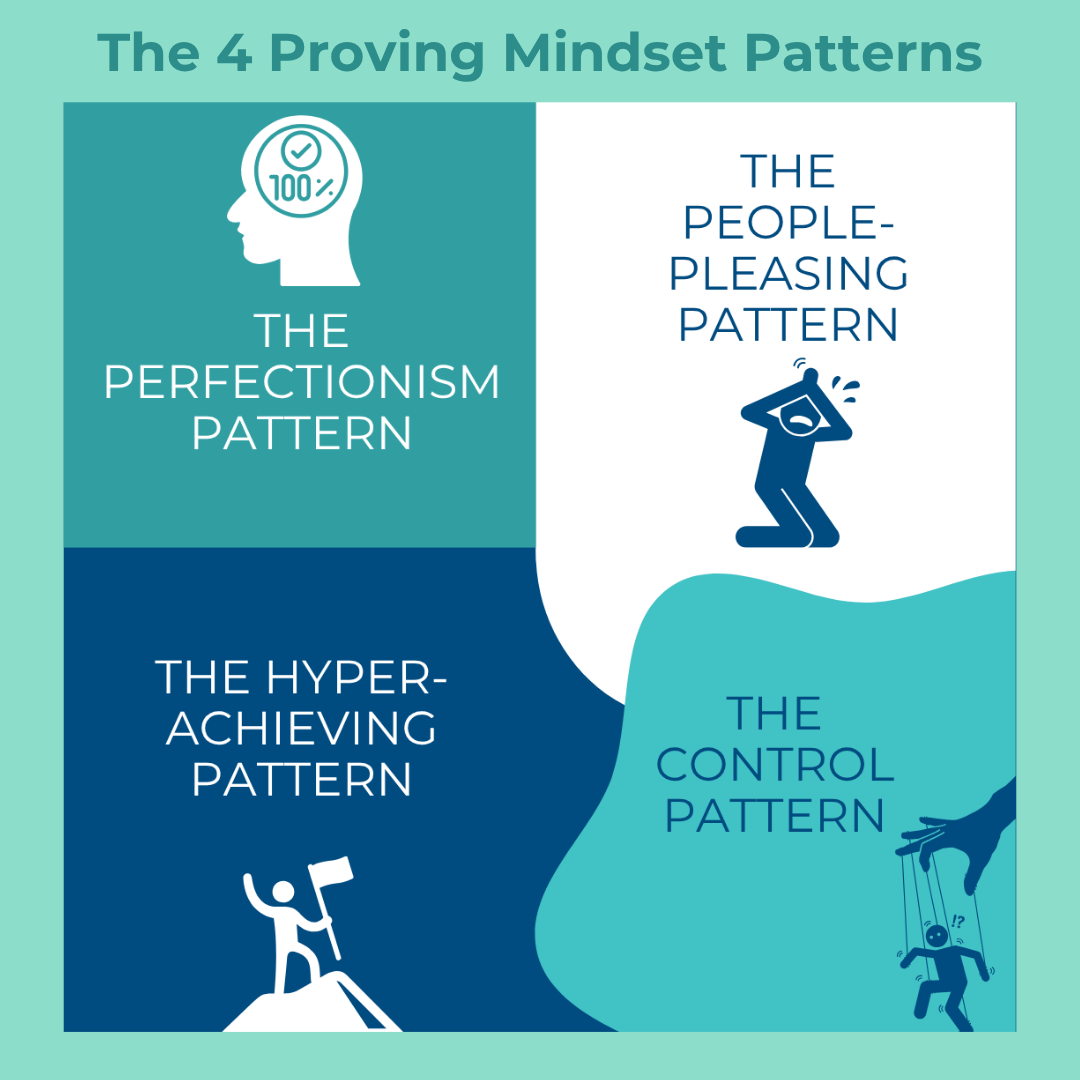
But the proving mindset does not look the same in every leader. It has four distinct patterns, and knowing which one is yours is the difference between vague self-awareness and actual change.
This post covers the four proving mindset patterns I see most often in coaching. All of them are familiar. All of them made sense at some point. And all of them have a ceiling.
These Are Learned Behaviors, Not Character Flaws
Before we name the patterns, it matters to say this clearly: none of these are who you are. They are strategies you developed and learned over time. In most cases, they helped you navigate high-stakes environments, earn trust, get results, and advance. The proving mindset, in its earlier forms, is often what got a leader to where they are.
The problem is not that you developed these patterns. The problem is that they have a breaking point, and most leaders hit it right around the time their scope of responsibility grows beyond what willpower and individual effort can manage.
📖 Keep reading: what got you here won’t get you there
📖 Keep reading: 12 habits
Pattern 1: The Perfectionism Pattern

The perfectionism pattern sounds like a humble brag. It does not feel like one from the inside.
Leaders carrying this pattern have typically spent years setting standards that drove real quality. That part was true. But over time, those standards stopped being a tool and started being a test. If something is not done exactly right, it does not count. If they cannot make it excellent, they would rather keep holding it than let it go. The underlying proving question: if this is not excellent, does it confirm that I am not?
What it looks like in practice:
Delegating tasks and then quietly redoing them
Feedback that sounds like coaching but functions like control
Projects that stay in revision longer than they should
A team that has learned to wait for your version rather than produce their own
One client, a VP of Product, described reviewing the same three-slide deck for the fourth time before a board presentation. Her team had done good work. She knew it. But she could not stop adjusting. When I asked what she was afraid would happen if she submitted it as-is, she paused for a long time. “I’m afraid that if it’s not perfect, they’ll focus on the gaps and not on the substance. I need them to see the work my team has done, and not get caught in nitpicking mode.” That answer told us everything we needed.
The lesson: Perfectionism does not scale. As scope grows, the number of things requiring your perfect touch grows with it. The team stops developing because their work is always modified before it reaches the finish line. The leader stops sleeping because nothing is ever done. And the quality that perfectionism was meant to protect starts suffering under the weight of its own protection.
The shift: A leader operating from a grounded mindset still holds high standards. But the standard is a tool in service of quality, not a measure of their worth. They can submit work their team produced and take genuine pride in that. They can hold high expectations without having to personally enforce every detail. The difference is not lower standards. It is standards held from security rather than fear.
Pattern 2: The People-Pleasing Pattern
The people-pleasing pattern is one of the most energy-intensive things a person can do while appearing, from the outside, to be entirely agreeable and easy to work with.
Leaders with this pattern made approval a strategy a long time ago. In environments where relationships mattered, where conflict was costly, or where being liked kept things smooth, learning to accommodate, deflect, and absorb was genuinely useful. It kept the peace. It built goodwill. It often created real warmth. The underlying proving question: if someone is unhappy with me, does that mean I am not enough?
What it looks like in practice:
Saying yes to things before assessing whether you have the capacity
Avoiding direct feedback because you do not want to disappoint
Taking on other people’s problems so they do not have to sit with discomfort
A persistent fear of being a burden, which means not asking for help or delegating work
Leaving one-on-ones feeling like you managed the other person’s feelings rather than led the conversation
One client described a pattern she had never named: she would sit in a meeting, hear a decision being made that she disagreed with, and say nothing. Then she would spend the next two weeks compensating for the decision through overwork, quietly absorbing the consequences of something she had the authority to push back on. “I thought I was being a team player,” she told me, “but it’s just one more example of where I probably should have voiced my opinion and pushed back on the idea.”
The lesson: People-pleasing is not sustainable, and it is not actually kind. Leaders who cannot hold limits model limitlessness for their teams. They normalize overcommitment. They deprive people of honest feedback that would help them grow. And eventually, the accumulated resentment of never being able to say what they actually think begins to corrode both the leader’s energy and the relationships they were working so hard to protect.
The shift: A leader operating from a grounded mindset can disagree without it threatening the relationship. They can say no and mean it. They can deliver honest feedback because they trust that honesty, offered with care, builds more real connection than accommodation does. The warmth does not disappear. It becomes more honest, and therefore more durable.
Pattern 3: The Hyper-Achieving Pattern
The hyper-achieving pattern is the one most likely to be praised, promoted, and completely misunderstood.
Leaders with this pattern have built their entire professional identity on output. Not just because they enjoy working hard, but because output became, at some point, the most reliable measure of their value. When you produce, you are safe. When you stop producing, you are not sure who you are. There is always more to do, doing less feels like falling behind, and rest feels like a risk you cannot afford. The underlying proving question: if I slow down, will it become clear that I am not as indispensable as I need to be?
What it looks like in practice:
A to-do list that grows faster than it empties, and that feels like proof of your worth
Difficulty being present, because you are always mentally three tasks ahead
Discomfort with strategic thinking or long meetings because they do not produce immediate, visible output
A quiet conviction that you are more productive than your team, even when the evidence does not support it
One client, a Director at a consulting firm, told me she felt genuinely anxious on days when she cleared her inbox. “I should feel good about it,” she said. “But I just feel like I’m missing something. Like I’m not doing enough.” She had built her sense of safety entirely on being busy. When the busyness paused, even for an afternoon, the anxiety rushed in to fill the space.
The lesson: Hyper-achieving leaders are often, paradoxically, operating well below their actual capacity. They are so busy producing that they have no time to think strategically, develop their teams, or make the kinds of decisions that require space and stillness. For these leaders, relaxing is impossible. And tying value to output is a recipe for burnout when that external validation stops happening. They also model something their teams absorb: that output is the measure of value, that rest is weakness, and that your worth is conditional on how much you accomplish today.
The shift: A leader operating from a grounded mindset can close the laptop, not because the work is done, but because their sense of worth does not live in the inbox. They can think strategically rather than just productively, because strategic thinking requires the kind of space that busyness makes impossible. And they can model something entirely different for their teams: that output is something you produce, not something you are.
Pattern 4: The Control Pattern
The control pattern is the most misunderstood of the four, because it is almost always accompanied by a genuine belief that it is in service of the team.
Leaders with this pattern are not trying to micromanage. They are trying to protect. At some point, often early in their career, they learned that things go wrong when they are not watching. A project failed when they delegated. A detail was missed when they stepped back. And their nervous system drew a conclusion: oversight equals safety. Letting go equals risk. The underlying proving question: if something goes wrong on my watch, is that evidence I was not capable enough to prevent it?
What it looks like in practice:
Staying involved in decisions that are well below your pay grade
Being the bottleneck for approvals that should not require your sign-off
A team that has learned not to make decisions without checking first, which means they have also stopped developing judgment
An instinct to re-explain, re-check, and re-confirm, even with people you trust
One client, a senior operations leader, came into coaching describing a team he felt he could not rely on. They missed things. They needed constant direction. They could not seem to work independently. When we started mapping what his team actually experienced, a different picture emerged: they had learned, over two years, that their manager would catch whatever they missed, so they had stopped catching it themselves. The team he thought he was protecting had been, very quietly, disempowered.
The lesson: The control pattern creates the exact conditions it is trying to prevent. When a leader never fully trusts their team, the team never fully develops. When oversight is constant, initiative disappears. When every decision runs through one person, the organization becomes as scalable as that one person, which is not very scalable at all.
The shift: A leader operating from a grounded mindset can hand something off and let it land. They can trust that a mistake their team makes is an opportunity to develop judgment, not evidence that closer oversight was warranted. A team trusted enough to figure things out develops in ways a closely managed team simply cannot. The goal shifts from preventing failure to building capacity.
What All Four Have in Common
Different as they look, these four patterns share the same root: a proving mindset organized around a specific strategy for staying safe.
Perfectionism says: if it is excellent, they cannot criticize me. People-pleasing says: if everyone is happy, I am safe. Hyper-achieving says: if I produce enough, my value is undeniable. Control says: if I watch everything, nothing can go wrong.
Each strategy made sense. Each one worked, for a while. And each one has a ceiling that eventually becomes a floor.
The shift is not about dismantling these patterns. It is about having a choice about when they run the show. That is where the work actually starts. And it is the same place the Mindset + Energy = Impact framework always begins: with an honest look at what is actually driving the behavior beneath the behavior.
📖 Keep reading: Mindset + Energy = Impact: The Framework Behind Every Conshy Coaching Engagement
📖 Keep reading: Why High-Achieving Women Leaders Burn Out Faster (And What to Do About It)
If you recognized yourself in more than one of these patterns, that is common. Most leaders have a dominant pattern and a secondary one. If you are ready to understand yours more clearly, and to do something about it, I would love to talk. Schedule a complimentary exploration call at conshycoaching.com/imready. I help high-performing leaders and teams reduce decision fatigue and emotional overload so they can think strategically, communicate with clarity, and lead sustainably without burning out

Frequently Asked Questions
-
The proving mindset is a leadership pattern in which a person’s decisions, behavior, and self-assessment are filtered through the question: does this confirm that I belong here? It is characterized by self-monitoring, reactivity to feedback, and a deep need to demonstrate competence, worth, or value. It typically develops as an adaptive strategy early in a career and becomes problematic as leadership scope grows.
-
The four most common proving mindset patterns in leadership are: perfectionism (standards as protection from criticism), people-pleasing (approval as a strategy for safety), hyper-achieving (output as the measure of worth), and control (oversight as a way to prevent things from going wrong). Each pattern is a learned behavior that served a purpose and has a ceiling.
-
Leadership perfectionism shows up as delegation avoidance, quietly redoing work others have completed, feedback that functions as control, and projects that stay in revision longer than necessary. The underlying fear is that work that is not perfect will reflect poorly on the leader’s worth or competence. The ceiling is that it does not scale: the team stops developing and the leader burns out maintaining standards no single person can sustain.
-
People-pleasing erodes a leader’s authority, drains their energy, and models limitlessness for their team. Leaders who cannot hold limits normalize overcommitment, withhold honest feedback, and accumulate resentment from never being able to say what they actually think. It is one of the most energy-intensive patterns in leadership, precisely because it looks like agreeableness from the outside while creating significant internal strain.
-
Most leaders have a dominant pattern and a secondary one. The clearest way to identify yours is to notice where your behavior is driven by fear rather than choice: Where do you over-function? Where can’t you let go? Where does saying no feel impossible? Coaching is one of the most effective ways to identify your dominant pattern and begin shifting from proving to grounded.