Book Review: The Disease to Please by Harriet Braiker. The Best Coaching Manual on People-Pleasing You've Never Thought to Pick Up
Why I Picked This Book
People-pleasing is one of the most common patterns I work with in women leaders. It looks professional, collaborative, empathetic and supportive. But over time, it quietly destroys credibility, erodes energy, and creates a deep disconnect between who a leader is and how she shows up.
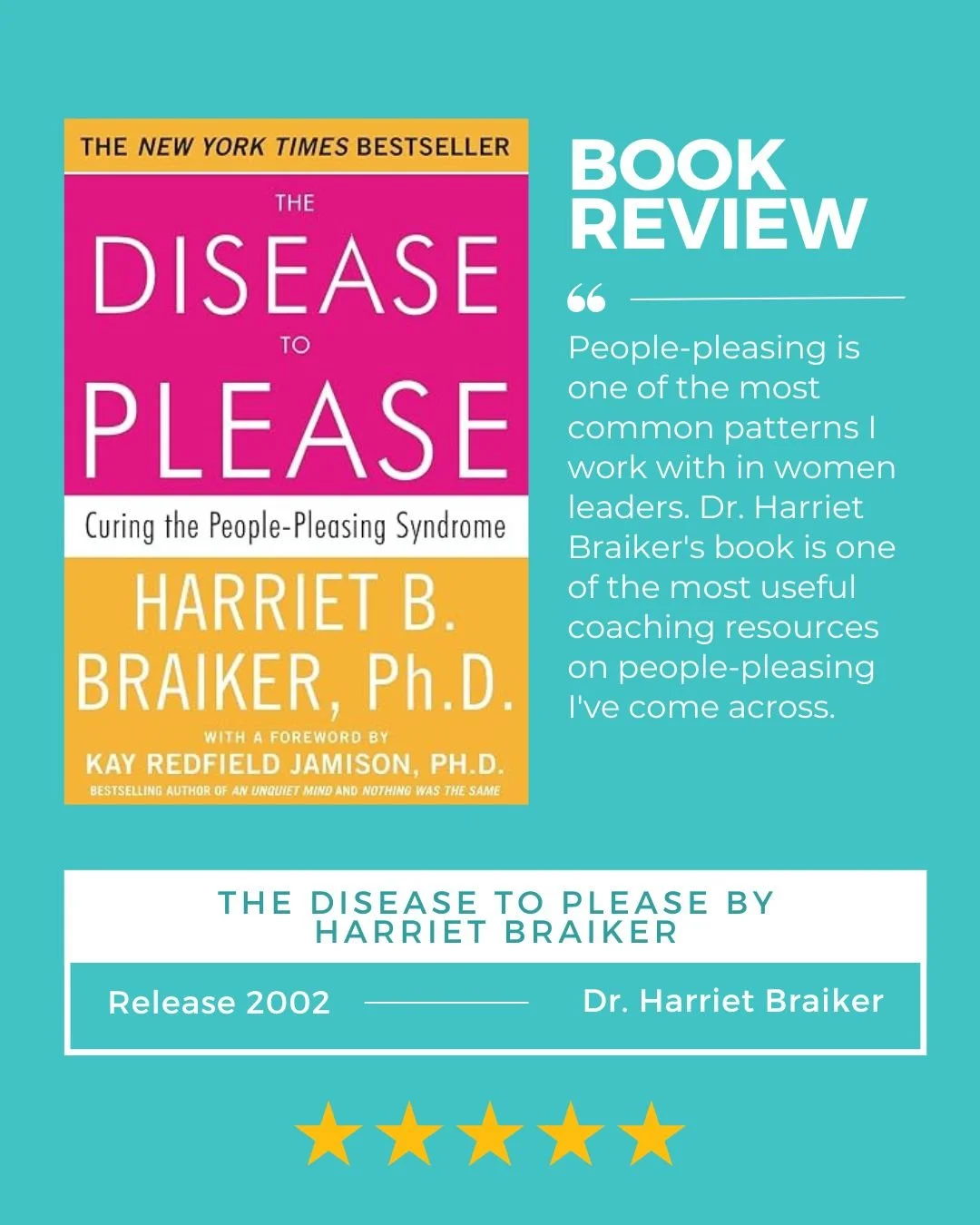
Dr. Harriet Braiker's book is one of the most useful coaching resources on people-pleasing I've come across. While the book does take a clinical approach, and uses words like disease and syndrome, it reads the way my coaching engagements feel: here's where you are, here's why you got here, here's what you're going to do about it. With a self-assessment, behavioral framework, and 21-day action plan built in, it becomes a practical tool for anyone looking to unlearn their people-pleasing tendencies.
📖 Keep reading: The People-Pleasing Trap: How Saying Yes Is Costing You Your Leadership
The Big Idea
Most people treat people-pleasing like a personality trait, something fixed that they were born with. Braiker pushes back on that idea. Her central argument is that people-pleasing is a learned behavior pattern driven by fear, and that learned behaviors can be unlearned with the right structure and enough practice.
Braiker explains that there’s a difference between being genuinely kind and being compulsively accommodating. Genuine kindness is authentic, grounded in a desire to collaborate, grow and succeed. Compulsive accommodation is fear-based, driven by the need to avoid conflict, disapproval, or someone being upset with you. Compulsive accommodation isn’t kindness, it's self-protection. And worse, your team stops getting the candid feedback they need to grow, your credibility quietly erodes, and you end up more depleted than the work itself would require.
This isn't a comfortable read. Braiker holds a mirror up to patterns that most high-achievers have been rewarded for their entire careers, and the recognition can sting. But it's one of the most practically useful books I've encountered on this topic, because it doesn't let people-pleasing tendencies hide behind the language of kindness or professionalism. If you've ever left a meeting feeling resentful about something you agreed to, this book is for you.
📖 Keep reading: How Women Rise, by Sally Helgesen & Marshall Goldsmith
Key Learnings
1. The People-Pleasing Triangle
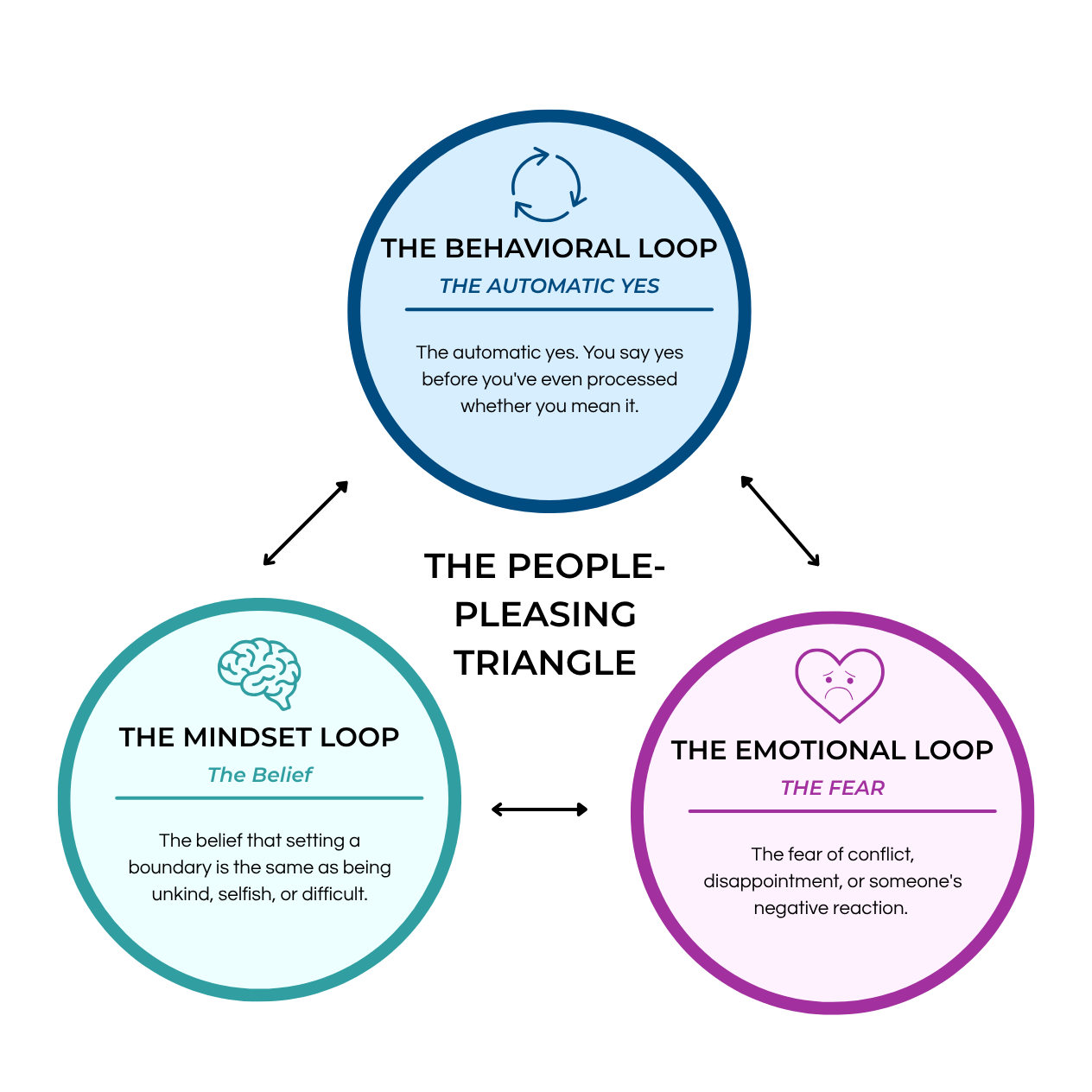
Braiker identifies three interconnected loops that keep people-pleasing in place. Understanding which one is most active for you is the first step toward changing it.
The Behavioral Loop: The automatic yes. You say yes before you've even processed whether you mean it. The behavior is so habitual it bypasses conscious thought entirely.
The Mindset Loop: The belief that setting a boundary is the same as being unkind, selfish, or difficult. If this loop is running, saying no feels like a character violation, not a reasonable response.
The Emotional Loop: The fear of conflict, disappointment, or someone's negative reaction. Even when you know you should hold a line, the anticipation of someone being upset overrides your intention.
Most people-pleasers have all three running simultaneously. But there's usually a dominant one, and identifying yours changes what you work on first.
2. Start With a Self-Assessment, Not a Solution
Before offering any strategies, Braiker opens with a diagnostic quiz that asks you to take stock of where you are. It might be uncomfortable, but by helping you define your starting point, she takes people-pleasing from a vague, uncomfortable feeling to a visible, measurable pattern, rather than something you keep dismissing as "just how I am."
3. The Approval Addiction Is a Real Feedback Loop
Braiker explains that for chronic people-pleasers, approval functions like a reward stimulus. You say yes, you get a positive reaction, you feel relieved. That relief is reinforcing. Over time, the brain learns that accommodation equals safety, and disagreement equals threat.
This isn't a character weakness or personality flaw, it's a learned neurological pattern. And it's why telling yourself to "just say no" doesn't work. You're not overcoming a preference; you're working against a well-established feedback loop. Which is why her 21-day behavioral conditioning program exists. (See Key Learning 5 for more on this program!)
4. Guilt Is Information, Not Instruction
Something I hear a lot from clients is the guilt they feel about defining, communicating, and holding boundaries. Braiker explains that this guilt isn't evidence that they did something wrong, it's evidence that they did something unfamiliar.
Guilt, in this context, is a signal that a pattern has been interrupted, not a signal to reverse course. For high-achieving leaders who have been well-trained to take their emotional responses seriously, this distinction is both uncomfortable and genuinely liberating.
When my clients first start the hard work of unlearning their people-pleasing tendencies, by holding a line, delivering honest feedback, or saying no to something they don't have bandwidth for, they spend the next hour second-guessing it. That rumination, guilt and other unpleasantries are just indicators that they've done something uncomfortable, and the protective part of their brain is screaming. In time, as their brains learn that pushing back is safe, that protective side stops screaming so loudly.
5. The 21-Day Program to Build Assertiveness
Braiker's 21-day behavioral conditioning plan helps you unlearn people-pleasing tendencies and build assertiveness incrementally, with low-stakes practice first and higher-stakes practice later.
It's a structured program designed around the reality that you can't go from chronic people-pleaser to direct communicator in a single conversation. You build the confidence muscle the same way you build any other muscle. You start light, you add resistance gradually, and you show your nervous system through repeated evidence that honesty is survivable.
Actionable Steps You Can Implement Today
These strategies come directly from the book's behavioral framework. You don't have to read the whole thing to put them to work.
1. Practice the Pause Before the Yes.
Braiker recommends breaking the automatic yes response by building in a mandatory pause. When asked to take on something new, your default response becomes: "Let me check and get back to you." Not a no. Just a pause that creates enough space for a considered response rather than a reflexive one.
2. Do the Cost Inventory.
This week, write down three decisions or conversations you've been avoiding because of how someone might react. For each one, ask: what is the cost of continuing to avoid this? What is the cost to my team, my credibility, my own sense of integrity? When you make the cost of people-pleasing visible, the motivation to change it increases significantly.
3. Use the Sandwich Technique for Communicating Boundaries.
Braiker offers a communication formula for delivering a boundary without it landing as aggression or rejection. You sandwich the limit between two validating statements.
Example:
"I'm glad you came to me with this project. I can't take it on right now given current priorities. Please keep me in mind for future quarters."
It signals genuine care for the relationship while still being clear about what you're able to do. It's not the apologetic version, which buries the message in qualifiers. And it's not the blunt version, which can feel abrupt. It's warm and direct at the same time.
4. Separate Their Reaction from Your Responsibility.
Write this somewhere you will see it: I am responsible for my communication. I am not responsible for their reaction to it.
Your job, as a leader, is to act with integrity and respect, while also holding your team accountable to delivering on key objectives and results. It’s not to be liked. When you give people an honest no, you're treating them as capable adults who can handle reality. When you give a resentful yes, you're managing them like children who can't. Which is more respectful?
5. Start With Low-Stakes Situations First.
Before you practice holding a boundary with your CEO, practice with a stranger. Braiker's 21-day program builds from genuinely low-stakes situations: declining a receipt, turning down a salesperson, saying no to a minor request from a colleague you barely know.
This isn't busywork, it's neurological conditioning. Each time you hold a small line and the world doesn't end, you're building evidence that disagreement is survivable. That evidence is what your nervous system needs before it will let you try the harder conversations.
The Bottom Line
Effective leadership requires making decisions that not everyone will like, delivering feedback that is uncomfortable, holding lines that create friction. A leader who can't tolerate any disapproval will consistently choose comfort over courage, and their team will eventually stop trusting them to lead.
The Disease to Please isn't asking you to diagnose yourself with something or submit to a treatment plan. It's asking you to look honestly at a behavioral pattern that most high-achieving leaders have been running on autopilot for years, and then giving you a concrete, structured way to interrupt it.
In my practice, I talk to clients about a four-step process to change: awareness, acceptance, conscious choice, and trusting the process. Braiker's 21-day program is built for that fourth stage, giving you a structured path through the discomfort rather than asking you to white-knuckle your way to new behavior.
Change doesn't happen in a single brave conversation it happens in the accumulation of a hundred small ones. You're not going to feel confident before you start, you're going to feel confident because you started. This book will help you do just that.
📖 Keep reading: The People-Pleasing Trap: How Saying Yes Is Costing You Your Leadership
📖 Keep reading: What Got You Here Won't Get You There by Marshall Goldsmith
Ready to put these insights into action with a guide who has done the reading and the work? Schedule a complimentary exploration call at conshycoaching.com/imready.
-
Despite the clinical-sounding title, the book functions more like a coaching manual than a therapy resource. It's built around a behavioral framework, a self-assessment quiz, and a structured 21-day action plan. The focus throughout is on recognizing patterns and changing behavior incrementally, which is how good coaching works.
-
Dr. Braiker identifies three interconnected loops that keep people-pleasing in place: the behavioral loop (saying yes automatically), the mindset loop (believing that boundaries equal cruelty or selfishness), and the emotional loop (fear of conflict or negative reactions from others). Understanding which loop is driving your behavior is the first step toward changing it.
-
Leaders who recognize that they consistently put others' comfort ahead of their own needs, struggle to say no without guilt, apologize reflexively, avoid conflict at personal cost, or feel responsible for how others react to their decisions. It's especially useful for high-achieving women who have been rewarded throughout their careers for accommodating behavior and are now hitting the ceiling of that strategy.
-
The final third of the book is a structured, 21-day behavioral conditioning program that builds assertiveness incrementally. It starts with low-stakes practice situations and gradually moves toward higher-stakes ones, building the confidence muscle through repetition and evidence rather than willpower alone.
-
The book's framework maps directly onto the awareness, acceptance, conscious choice, and trusting the process model used in coaching. It gives leaders a diagnostic entry point (the self-assessment), a conceptual framework (the three loops), and a structured behavioral program (the 21 days) rather than asking them to simply decide to be different. That combination is what makes it coaching-adjacent rather than purely therapeutic.