Why Leaders Resist Uncertainty (and How to Train Your Brain to Handle It Better)
A recent article in Psychology Today explored something most of us feel but rarely name: humans are wired to resist uncertainty. Our brains treat “not knowing” as a potential threat. Yet uncertainty is also the source of learning, innovation, and growth. (psychologytoday.com)

This tension is at the heart of modern leadership.
The real challenge is not removing uncertainty. It is building the capacity to move forward with it. That is where mindset and energy come in. Because the way leaders think and the state they operate from directly shape the impact they have on their teams, decisions, and results.
Why the Leadership Brain Resists Uncertainty
From a biological perspective, your brain is designed to protect you, not to help you lead in complex, fast-moving environments. Uncertainty activates threat responses. This often shows up as anxiety, rigid thinking, and a strong desire for control. The problem is that these reactions can quietly undermine leadership effectiveness.
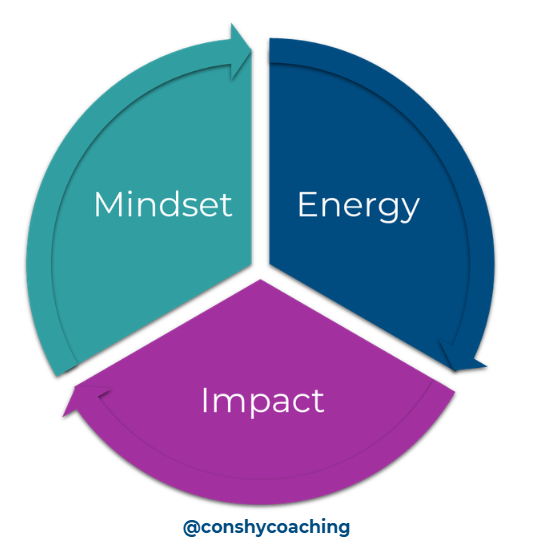
This is where the Mindset + Energy = Impact framework that I like using when I work with leaders and teams becomes practical, not theoretical.
When leaders experience uncertainty, three things happen:
1. Mindset narrows
Leaders move into defensive thinking. They focus on risk, failure, or worst-case scenarios. This is not a lack of skill. It is a nervous system response.
They may:
Delay decisions
Overanalyze
Seek excessive validation
Avoid difficult conversations
2. Energy becomes reactive
When the brain perceives threat, leaders operate from tension, urgency, and pressure. Their presence shifts. Teams feel it immediately.
This is where over-functioning often shows up. Leaders step in, solve, and control. In the short term, this reduces discomfort. In the long term, it erodes ownership and confidence in the team.
3. Impact decreases
Even highly capable leaders unintentionally create:
Slower decision cycles
Less innovation
Lower engagement
Increased dependency
The issue is rarely competence. It is how the leader’s mindset and energy shape the environment around them.
The Types of Uncertainty Leaders Face Every Day
Most leadership roles involve constant ambiguity. It just does not always get labeled that way.
Strategic uncertainty
Shifting markets, emerging technology, and unclear long-term direction.
This requires flexibility and the willingness to move forward without perfect information.
People uncertainty
How individuals and teams will respond to feedback, change, or pressure.
This includes:
Retention and engagement
Conflict and collaboration
Readiness for growth
Trust and psychological safety
Decision uncertainty
Most leadership decisions are made with incomplete data. Waiting for certainty often creates more risk than acting thoughtfully.
Identity uncertainty
This is the most personal and often the least discussed.
Who am I if I am not the expert?
What if I am wrong?
What if my credibility is questioned?
This internal uncertainty often drives the external behaviors.
Why Avoiding Uncertainty Increases Stress
Many leaders try to reduce stress by eliminating uncertainty. The opposite tends to happen.
Avoidance leads to rumination, emotional exhaustion, and chronic tension. The nervous system stays in a heightened state of alert. Over time, this contributes to burnout and poor decision-making.
Resilience research consistently shows that the ability to regulate emotional and physiological responses in uncertain environments improves performance and recovery. In other words, stress does not come from uncertainty itself. It comes from resistance to it.
This is why developing capacity, not control, becomes the leadership advantage.
Training the Leadership Brain: A Mindset + Energy Approach
When I work with leaders and teams, we do not just talk about uncertainty. We train for it. Because awareness alone does not change behavior. Practice does.
Here are the core areas we focus on.
1. Expanding mindset under pressure
Leaders learn to recognize when they move into protective thinking and how to shift toward possibility and clarity.
This includes:
Identifying cognitive distortions
Expanding perspective
Practicing flexible thinking
Separating facts from assumptions
A simple but powerful shift is asking, “What else might be true?” This opens space for better decision-making.
2. Regulating energy and presence
Most leadership development ignores the nervous system. Yet this is where the real leverage is.
In coaching and training, we build practical skills such as:
Breath and attention training
Awareness of physiological stress signals
Short regulation practices that can be used in real time
Building the capacity to stay calm in high-stakes situations
This is not about being calm all the time. It is about having the ability to return to clarity quickly.
Teams experience this immediately. When leaders regulate themselves, teams feel safer, more focused, and more engaged.
3. Increasing tolerance for ambiguity
This is like building a muscle.
Leaders practice:
Making smaller decisions faster
Delegating outcomes instead of controlling process
Running experiments instead of waiting for certainty
Creating psychological safety around learning and iteration
Over time, the brain learns that uncertainty does not equal danger.
4. Creating structure without rigidity
High-performing teams do not eliminate uncertainty. They reduce chaos.
We work on:
Clear priorities
Decision frameworks
Communication rhythms
Defined ownership
Structure frees cognitive bandwidth so leaders can focus on what truly requires adaptability.
5. Modeling resilience for the team
Teams mirror the leader’s mindset and energy.
If leaders become reactive, teams become cautious and risk-averse. If leaders stay grounded and curious, teams become more innovative and solution-focused.
This is why leadership is not just about strategy. It is about emotional contagion and influence.
The Leadership Advantage

The leaders who will thrive in the next decade will not be those who know the most. They will be those who can stay steady, flexible, and human in the unknown.
They will:
Move forward without perfect clarity
Make thoughtful decisions
Empower others
Stay connected under pressure
Create environments where people feel safe to learn and adapt
Uncertainty is not going away. If anything, it will increase.
The opportunity is not to control it. The opportunity is to build the mindset and energy that allows you to meet it with clarity and intention.
Because in the end, the impact you have as a leader is not defined by how much certainty you have. It is defined by how you show up when you do not.